Patient Safety Starts Before Care: The Invisible Role of Testing and Compliance
September 17, 2026
Share article



Every year, World Patient Safety Day shines a spotlight on the systems, processes and practices that protect people from avoidable harm in healthcare.
There is good reason for that focus. According to the World Health Organization’s patient safety data on preventable harm in healthcare, around 1 in 10 patients experiences harm in healthcare, with more than half of that harm considered preventable.
Much of the patient safety conversation understandably focuses on the point of care: preventing medication errors, infections, diagnostic errors and unsafe procedures.
But patient safety starts much earlier.
Before a medicine, medical device, cosmetic or healthcare product reaches the person who will use it, it has already passed through a long chain of development, laboratory testing, safety assessment, clinical research, quality control and regulatory compliance.
For medicines, the FDA’s five-stage drug development and safety monitoring process illustrates that lifecycle clearly: discovery and development, preclinical research, clinical research, regulatory review and post-market safety monitoring.
Testing and compliance sit throughout that process, providing evidence that products and processes meet the standards designed to protect the people who ultimately rely on them.
How do testing and compliance support patient safety?
The WHO describes patient safety as the processes, procedures, cultures, technologies and environments in healthcare that consistently and sustainably lower risks, reduce avoidable harm, make errors less likely and reduce the impact of harm when it does occur.
Achieving that depends on controls operating at many different levels.
Regulatory requirements establish standards that medicines and healthcare products, manufacturers, laboratories and clinical research organisations need to meet. Testing provides evidence against defined specifications and requirements. Quality assurance establishes the systems and processes used to maintain consistent quality, while quality control tests whether products meet the required standards.
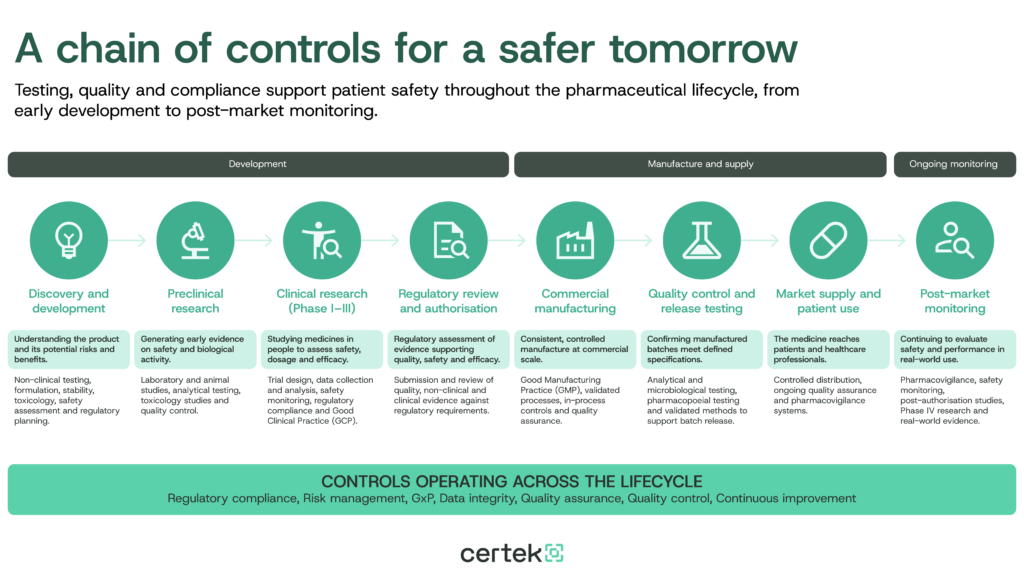
Together, these disciplines create a chain of controls across the product lifecycle.
In life sciences, regulatory compliance is ultimately a form of risk management. It creates a framework for identifying potential problems, generating reliable evidence and controlling risks before products reach the people who use them.
That process starts during development.
Patient safety starts during product development
Safety starts with understanding the product itself.
During drug development, researchers investigate factors such as dosage, potential toxicity, how a medicine behaves in the body and how it interacts with other treatments. The FDA’s guidance on research during drug discovery and development describes how development work examines factors including absorption, distribution, metabolism, excretion, dosage, adverse effects and interactions with other treatments.
Other healthcare and consumer products have their own development and regulatory pathways, but the same basic principle applies: safety and compliance need to be considered before a product reaches its intended user.
Take cosmetics as an example. In Great Britain, a cosmetic product must undergo a safety assessment before it is placed on the market. Under the UK regulatory requirements for cosmetic product safety assessments and Cosmetic Product Safety Reports, that assessment must consider the finished product, its intended use and anticipated exposure, using available evidence to demonstrate that it is safe for human health under normal or reasonably foreseeable conditions.
That assessment depends on evidence.
Advanced Development & Safety Laboratories (ADSL) supports businesses throughout the product development and safety lifecycle, with particular expertise across cosmetics, personal care and a range of other consumer products. Its integrated services span formulation development, stability and compatibility testing, microbiological testing, analytical chemistry, safety and toxicological assessment, clinical and efficacy testing, and regulatory compliance.
Stability and compatibility testing, for example, help establish how a formulation and its packaging perform over time and under different environmental and storage conditions. Microbiological testing helps identify and control contamination risks, while safety assessment brings together evidence relating to ingredients, toxicological profiles, exposure and the finished product to establish whether it can be considered safe for its intended use.
The relationship between robust testing and product safety is particularly clear in the regulatory framework governing cosmetic products. Evidence supporting a Cosmetic Product Safety Report (CPSR) may include the physical and chemical characteristics of the substances and finished product, stability, microbiological quality, preservative efficacy, impurities and traces, packaging materials and anticipated exposure.
Mark Bowes-Cavanagh, founder and CEO of ADSL and Chief Scientific Officer at Certek Group, has more than 25 years’ experience across formulation science, analytical and microbiological testing, toxicology, product safety and regulatory compliance. A Chartered Chemist, Chartered Scientist and Fellow of the Royal Society of Chemistry, with professional toxicology credentials in the UK and Europe, he founded ADSL in 2008 with the objective of bringing product development, laboratory testing, safety assessment and regulatory expertise together within one organisation.
As he explains:
“Good science early in development gives you a stronger foundation for everything that follows. Rigorous testing, appropriate safety assessment and well-designed quality systems help identify potential problems at a stage when they can still be properly understood and addressed, rather than allowing uncertainty or unnecessary risk to move further down the product lifecycle.”
This is an important part of consumer safety that takes place before a product reaches the marke; and potentially long before the person ultimately using that product ever gives its safety a second thought.
Clinical research: building reliable evidence for safety and efficacy
Although laboratory evidence can tell us a great deal about a product, it cannot fully predict how it will perform when used by people.
The FDA’s guidance on clinical research and the phases of clinical trials explains that preclinical research cannot substitute for studying how a drug interacts with the human body. Clinical trials progress through different phases, gathering evidence about safety, dose selection, efficacy, side effects and adverse reactions.
JSS Medical Research works across this clinical research lifecycle. As a full-service clinical research organisation (CRO), it supports pharmaceutical, biotechnology, medical devices, and nutraceutical sponsors by defining the clinical strategy, designing and executing fit-for-purpose Phase I-IV clinical trials (see Figure) and supporting market access and health economics and outcomes research.
The reliability of the evidence matters as much as generating it in the first place.
It begins with a study protocol that translates clinically relevant questions into fit-for purpose design, including the selection of the appropriate patient population, comparator, duration of follow-up, endpoints, and optimal statistical planning. Data collection with dependable data-capture systems, rigorous data collection, and medical and clinical monitoring then follow to protect participants, identify and evaluate emerging safety information, support protocol compliance and detect issues that could compromise critical data or the credibility of the results. All these steps can influence the conclusions ultimately drawn from a study. Data integrity is therefore central to both regulatory compliance and patient safety: regulators, healthcare professionals and patients need to be able to trust the evidence on which decisions about a product are based.
The MHRA’s current guidance on quality and risk proportionality in UK clinical trials reflects this through quality by design, risk-based quality management and proportionate oversight, alongside the requirements of Good Clinical Practice (GCP). The amended UK Clinical Trials Regulations took full effect in April 2026.
Dr Emmanouil Rampakakis, CEO and Chief Scientific Officer at JSS Medical Research, brings more than 20 years of experience across clinical research, academia and the pharmaceutical industry. His work has included the design, analysis and interpretation of over 200 clinical trials and studies, alongside his academic research at McGill University.
As he explains:
“The quality of evidence we generate determines the quality of decisions we make. Rigorous trial design, continuous monitoring, and appropriate controls are not a bureaucratic exercise. They are a direct investment in patient safety.”
Human testing is not limited to medicines either. ADSL conducts clinical testing and consumer user trials for cosmetics and consumer products, including claim substantiation and specialist studies. The purpose and regulatory context differ from pharmaceutical Phase I-IV clinical trials, but both demonstrate the importance of understanding products in real-world human use before they reach a wider population.
Pharmaceutical quality and compliance after approval
Regulatory approval is an important milestone. It doesn’t remove the need for ongoing pharmaceutical quality control.
Once a medicine has been developed and the necessary evidence generated, pharmaceutical manufacturing needs to reproduce that product consistently and to the required quality standards.
This is where Good Manufacturing Practice (GMP), quality assurance, analytical testing, method validation and quality control play a critical role. The MHRA maintains a wider framework of good laboratory, manufacturing, distribution and pharmacovigilance practices for medicines, covering controls at different stages of the pharmaceutical lifecycle.
GMP establishes requirements around how medicines are manufactured and controlled. Importantly, these quality controls do not suddenly appear at commercial launch. Investigational medicinal products used during UK clinical trials are themselves subject to specific GMP requirements, as set out in the MHRA guidance on Good Manufacturing Practice for investigational medicinal products used in clinical trials.
Analytical methods also need to be suitable for the decisions being made with their results.
The ICH Q2(R2) international guideline for validation of pharmaceutical analytical procedures states that the objective of analytical procedure validation is to demonstrate that a procedure is “fit for the intended purpose”. The guideline covers analytical procedures used for release and stability testing of commercial drug substances and products, while its scientific principles can also be applied during clinical development.
In practical terms, if an analytical method is being used to make decisions about the quality of a medicine, there needs to be evidence that the method produces reliable results.
Within Certek Group, both ARC Pharma and Aspire Laboratories provide pharmaceutical analytical testing services.
ARC Pharma is an MHRA GMP-certified contract testing laboratory providing analytical support across the pharmaceutical product lifecycle, including method development and validation, dissolution studies, pharmacopoeial testing, and batch release testing. Aspire Laboratories is also MHRA GMP accredited for quality control testing of human medicines, including chemical, physical and non-sterile microbiological analysis. Its services extend from analytical method development and validation through to batch release testing.
This work helps carry the quality established during product development into pharmaceutical manufacturing and, eventually, supply.
Quality control and batch release testing before medicines reach patients
There is an important distinction between approving a medicine and confirming the quality of the batches subsequently manufactured.
A medicine may have gone through years of research, clinical trials and regulatory review. Commercial manufacturing then needs to reproduce that product consistently.
Batch release testing and pharmaceutical quality control provide evidence that manufactured batches meet their defined specifications before release.
For ARC Pharma, this includes full specification testing to support product release, alongside pharmacopoeial testing, dissolution studies and other analytical services. Its laboratory tests a range of pharmaceutical dosage forms, including tablets and capsules, oral liquids, injectable products, creams and ointments, inhalers and nasal sprays.
In 2025 alone, ARC Pharma reports having successfully released 15,574 batches, supported by 64 analytical, quality and operational specialists.
For Ayan Patel, Director of ARC Pharma, the link between analytical testing and patient safety comes down to confidence in the quality of every batch:
“Every batch ultimately represents a product that someone is going to rely on. Our role is to generate accurate, reliable evidence that it meets the required quality standards before it moves further through the supply chain. That responsibility is what makes rigorous testing and strong quality systems so important.”
Several layers of pharmaceutical quality come together at this stage. Validated analytical methods provide confidence in the results used to assess a product. Quality control testing checks products against defined requirements. GMP quality systems govern how work is performed, documented, reviewed and investigated when something does not meet expectations.
The relationship with patient safety becomes very tangible here.
A specification on paper cannot protect a patient. It needs a reliable method for measuring whether the manufactured product meets it, qualified people to carry out the analysis and quality systems governing how the evidence is generated and acted upon.
Testing may feel far removed from the person who will eventually open a packet, use an inhaler or receive an injection. In reality, it is one of the controls sitting between pharmaceutical manufacturing and patient use.
Post-market safety monitoring and real-world evidence
The safety lifecycle doesn’t finish once a product reaches the market.
Clinical trials take place in controlled settings and involve a finite number of participants. Once a medicine is used more widely, across larger and more varied populations and over longer periods, new information can emerge.
The FDA’s guidance on post-market drug safety monitoring acknowledges this limitation explicitly: complete information about a medicine’s safety cannot be available at the time of approval. Understanding of its safety continues to develop over the months and years that follow.
That is why post-market safety monitoring, Phase IV clinical research, post-approval studies and real-world evidence have an important role.
JSS Medical Research works on both sides of market approval. Alongside Phase I-III development programmes, its services include Phase IV clinical trials, post-approval studies and real-world evidence.
These studies can help researchers, pharmaceutical companies and regulators understand how treatments perform in broader populations and identify safety signals or other outcomes that may not have appeared during earlier clinical research.
Patient safety therefore has no single finishing line. Evidence continues to accumulate throughout a product’s life.
Building patient safety across the life sciences lifecycle
World Patient Safety Day is an opportunity to look at the systems that prevent avoidable harm. Some of those systems are highly visible to patients. Others operate years, months or days before a product reaches them.
A formulation needs evidence to support its safety. Analytical methods need to produce reliable results. Human studies need to be properly designed, conducted and analysed. Pharmaceutical manufacturing needs controlled processes and robust quality assurance. Finished batches need quality control and release testing. Products and processes need to meet regulatory requirements. Safety evidence continues to develop after launch.
Across Certek Group, that work can be seen at different points in the life sciences lifecycle: ADSL in product development, laboratory and clinical testing, safety assessment and regulatory compliance; JSS Medical Research in Phase I-IV clinical research and post-approval evidence; and ARC Pharma and Aspire Laboratories in pharmaceutical analytical testing, method validation, quality control and batch release.
These are different disciplines, governed by different standards and serving different types of products. What connects them is the need for reliable evidence and effective controls.
Testing and compliance cannot eliminate every risk associated with healthcare. They can help organisations identify, measure and control risk throughout the product lifecycle.
When we talk about patient safety, the care a patient ultimately receives is only one part of the picture. Long before that moment, scientists, researchers, laboratories, quality teams and regulatory specialists have already been working to make that care safer.
Frequently asked questions
How does testing support patient safety?
Testing provides evidence that medicines and healthcare products meet defined safety, quality and performance requirements. From product development and clinical research to pharmaceutical quality control and batch release testing, it helps identify potential issues before products reach wider use.
What is batch release testing?
Batch release testing assesses whether a manufactured pharmaceutical batch meets its defined specifications before release. Depending on the product, this can include tests for characteristics such as identity, strength, purity, dissolution and microbiological quality.
What is the role of regulatory compliance in patient safety?
Regulatory compliance provides a framework for managing risk throughout product development, clinical research, manufacturing and post-market monitoring. Requirements such as Good Clinical Practice (GCP) and Good Manufacturing Practice (GMP) help ensure that research is conducted appropriately, medicines are manufactured and controlled consistently, and reliable evidence supports decisions throughout the product lifecycle.
Related articles
Explore all news
Certek Acquires Aspire Laboratories
We’re delighted to announce the acquisition of Aspire Laboratories, a UK-based GMP contract analytical and microbiology testing laboratory serving the…

The Fire Protection Association Joins Certek
We’re delighted to announce that the Fire Protection Association (FPA), the UK’s leading fire safety organisation, providing membership, training, fire…

Certek Group Invests for Growth: ADSL Acquires ADACT Medical Assets and Strengthens Group Leadership with Appointment of Chief Scientific Officer
Certek is delighted to announce a significant investment in our Life & Materials Sciences division, marking a new chapter of…
Speak to Our Specialists
Our experienced team is here to support you with expert testing, inspection, compliance, and assurance services.
Get in touch to discuss your requirements.